

Best Places to See Penguins: A Complete Guide to Antarctica, Argentina, and Beyond
Quick Answer:The best places to see penguins in the wild are the Antarctic Peninsula (gentoo, chinstrap, and Adélie penguins), Punta Tombo in Argentine Patagonia (the largest Magellanic penguin colony outside Antarctica), Boulders Beach in South Africa (African penguins), and Phillip Island in Australia (the world’s largest little penguin colony). Penguins live exclusively in the Southern Hemisphere — none live in the Arctic — so any real trip-planning starts with Antarctica, South America, South Africa, Australia, or New Zealand.
Here’s a stat that surprises almost everyone: there isn’t a single wild penguin anywhere near the North Pole. Not one. And yet “do penguins live in the Arctic” is still one of the most-searched penguin questions online, right alongside people trying to figure out where they can actually go see one.
That mix-up is understandable — polar bears, ice, snow, it all blurs together in the popular imagination. But it also means a lot of trip planning starts on the wrong foot, aimed at the wrong hemisphere entirely. This guide clears up the geography first, then walks through the actual best places to see penguins, from Antarctic expedition cruises to Argentina’s Patagonian coast to a beach in Cape Town where the birds simply show up on their own.
Where Do Penguins Actually Live?
Penguins are a Southern Hemisphere family, full stop. Depending on which taxonomic authority you follow, there are 17 to 19 recognized species — most current sources land on 18 — and every one of them breeds somewhere south of the equator, with a single, genuinely strange exception.
Common Mistake:Assuming penguins and polar bears share the same habitat. They don’t, and they never have. The two have never overlapped in the wild at any point in evolutionary history — one is an Arctic predator, the other a Southern Hemisphere seabird, and roughly 12,000 kilometers of the planet lie between their ranges at their closest point.
Do Penguins Live in the Arctic?
No. Penguins do not live in the Arctic. All 18 or so penguin species are native to the Southern Hemisphere, primarily Antarctica, southern Africa, Australia, New Zealand, and South America. The single exception is the Galápagos penguin, which lives directly on the equator, not in the Arctic Circle.
Are Penguins in Antarctica? Which Species Live There
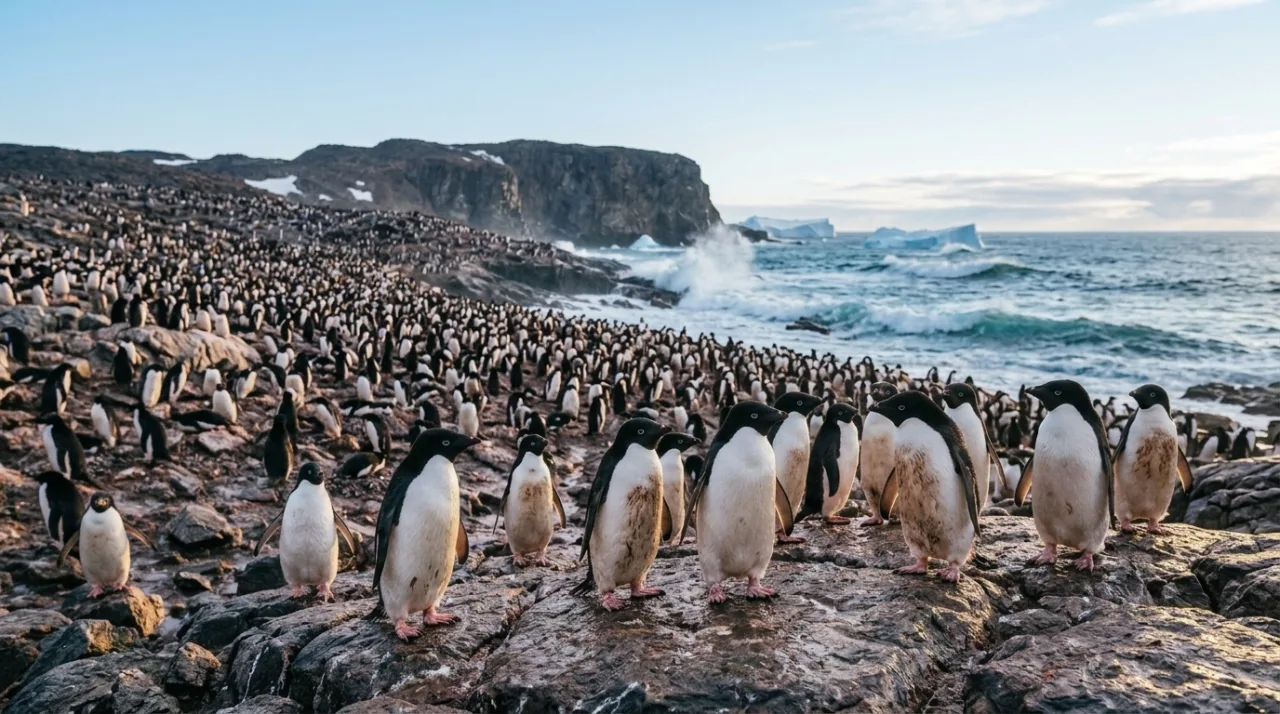
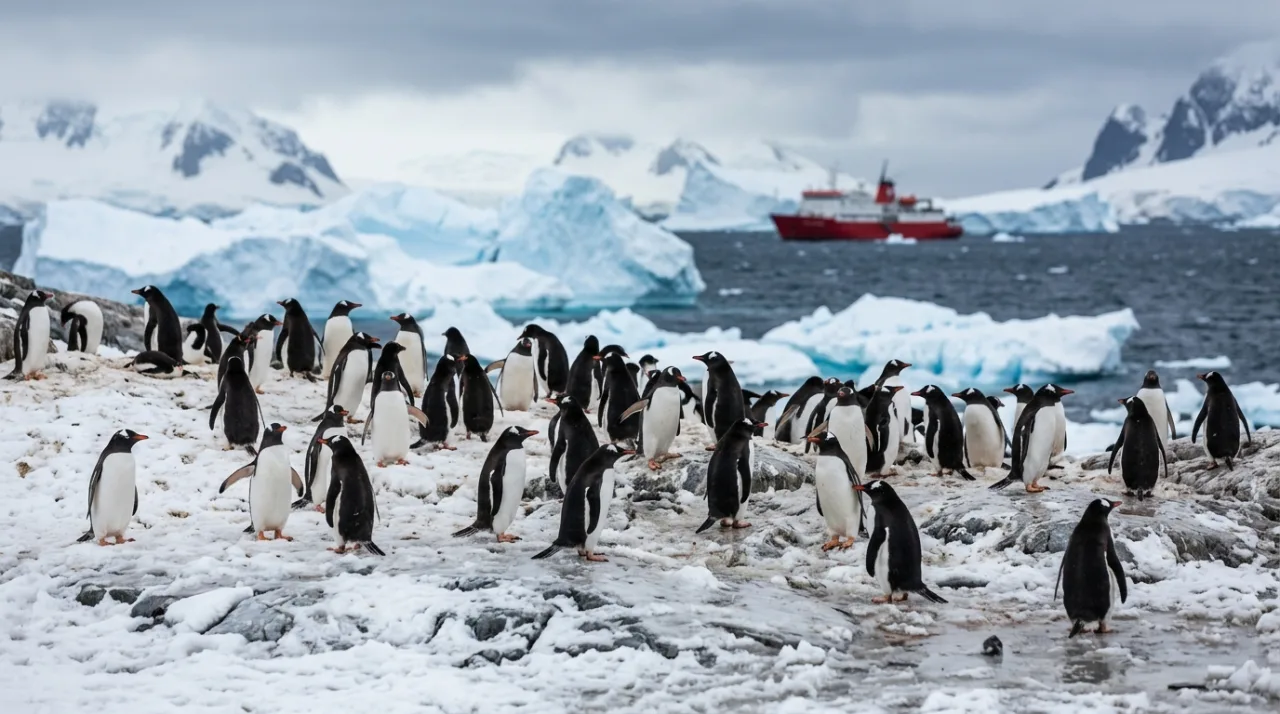
Yes, but fewer than most people assume. Only two species — the emperor and the Adélie — live on the Antarctic mainland year-round. Three more, chinstrap, gentoo, and macaroni penguins, also breed on the Antarctic Peninsula and nearby sub-Antarctic islands, bringing the total number of “Antarctic” penguin species to five. Between them, researchers estimate close to 5.77 million breeding pairs spread across roughly 698 nesting sites in the region, according to the Oceanites State of Antarctic Penguinsreport.
Pro Tip:If your goal is specifically an emperor penguin sighting, you’ll need a specialized fly-in expedition to the continent’s interior. The standard cruise-and-zodiac itinerary mostly reaches gentoo, chinstrap, and Adélie colonies along the Peninsula, rather than emperor colonies farther south.
Best Places to See Penguins in Antarctica
Here’s the thing about visiting the penguins of Antarctica: you’re not choosing one single site so much as booking a voyage that stops at several over the course of a week or two. Almost every Antarctica penguin tour departs from Ushuaia, Argentina, crosses the Drake Passage, and spends four to seven days landing at points along the Antarctic Peninsula.
Neko Harbor, Whalers Bay, Portal Point, and Danco Island rank among the most-visited landing points, each logging well over 150 tour landings in a single season. That traffic isn’t as heavy as it sounds. The International Association of Antarctica Tour Operators, known as IAATO, caps landings at 100 passengers ashore at any one site at a time, and only one ship may visit a given site at once.
Antarctic tourism has grown fast. The 2024–25 season brought roughly 118,000 visitors to the continent, and IAATO estimates put the 2025–26 season on track for around 128,000 visitors, more than double the figure from a decade earlier. What we consistently see isthat most of that growth comes from expedition-style ships carrying 100 to 200 passengers, the exact format built for close, well-managed wildlife encounters rather than mass tourism.
Featured Snippet: Best Time to Visit Antarctica for Penguins
The Antarctic tourist season runs November through March. November–December suits courtship and nesting behavior; January–February is peak season for hatched chicks; and late February–March brings strong whale sightings alongside molting adult penguins.
But here’s where it gets interesting: emperor penguins, the species most people picture first, are the hardest to actually see. Emperor colonies sit on fast sea ice well south of the Peninsula, reachable mainly through pricier fly-cruise combinations out of Punta Arenas, Chile, rather than the standard Ushuaia route. If an emperor sighting is the whole point of the trip, confirm that the itinerary specifically mentions access to the emperor colony before booking.
Argentina and Patagonia: South America’s Penguin Capital
If a full Antarctic voyage isn’t in the budget or the schedule, Argentina penguins are the next best thing, and for a lot of travelers, honestly the better choice. Patagonia penguins are dramatically easier to reach, dramatically cheaper to see, and in some cases more numerous than what you’d find on a single Peninsula landing.
Punta Tombo, Chubut Province
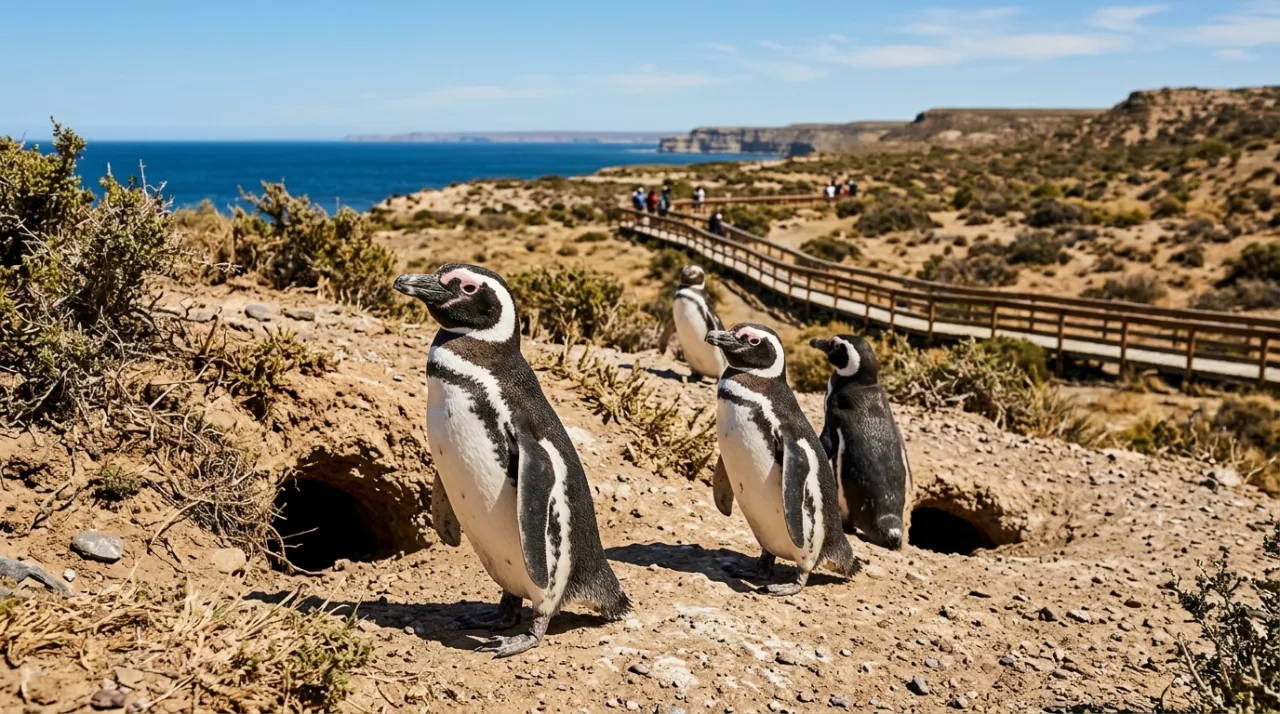
Punta Tombo, on Argentina’s Atlantic coast in Chubut Province, holds the largest continental colony of Magellanic penguins (Spheniscus magellanicus) on Earth. Estimates vary by year and survey method. The Wildlife Conservation Society, which has run a continuous census of the colony since 1982, puts the current breeding population at around 200,000 pairs — though the colony has declined by roughly 22% since long-term monitoring began in 1987, according to WCS researcher Dr. Dee Boersma, while other seasonal counts describe upward of a million individual birds across the wider reserve during peak months. Either way, it’s the single largest concentration of penguins in Argentina, and one of the largest anywhere outside Antarctica.
Common Mistake:Visiting outside breeding season. Punta Tombo is dramatically less interesting from roughly April through August, when most of the colony has migrated north to feed. Plan for the September–March window instead, with October through January as the sweet spot for chicks.
The reserve draws close to 100,000 human visitors a year, walking raised boardwalks that bring you within a few feet of nesting burrows. It’s also worth knowing that Magellanic penguins are currently classified as Least Concern on the IUCN Red List, but with a decreasing population trend — one long-term colony tracked by University of Washington researcher P. Dee Boersma has fallen more than 20% over 22 years, driven by rising extreme-heat days and offshore oil pollution, according to IUCN Red List data and Boersma’s published research.
Other Patagonia Penguin Spots
Punta Tombo isn’t the only option in the region. Península Valdés, a few hours north, combines penguin viewing with whale, sea lion, and orca sightings in a single day trip. Farther south, Tierra del Fuego and the Beagle Channel host smaller Magellanic colonies alongside occasional gentoo and king penguin sightings, which makes them a natural add-on for travelers already heading toward Ushuaia to catch an Antarctica cruise.
Other South American Penguins
South America penguins aren’t limited to Argentina. Chile’s Magdalena Island and the Strait of Magellan support significant Magellanic colonies, and the country’s Parque Pingüino Rey is one of the only mainland sites in the world where visitors can reliably see king penguins outside a remote sub-Antarctic island. Farther north, Peru’s coastline supports small Humboldt penguin populations, drawn in by the cold, nutrient-rich Humboldt Current running up from the south.
South American penguins as a group are almost entirely Magellanic and Humboldt species, a different lineup from the Antarctic five, which is exactly why pairing an Argentina trip with an Antarctica cruise gives you a genuinely different set of birds rather than more of the same.
The Falkland Islands, a short flight from mainland Argentina, deserve a mention here too, even though they’re a British Overseas Territory rather than part of South America proper. The Falklands host five breeding species, including king, gentoo, rockhopper, and Magellanic penguins, often in colonies that are easier to approach on foot than anywhere else covered so far.
South Africa: Penguins on a City Beach
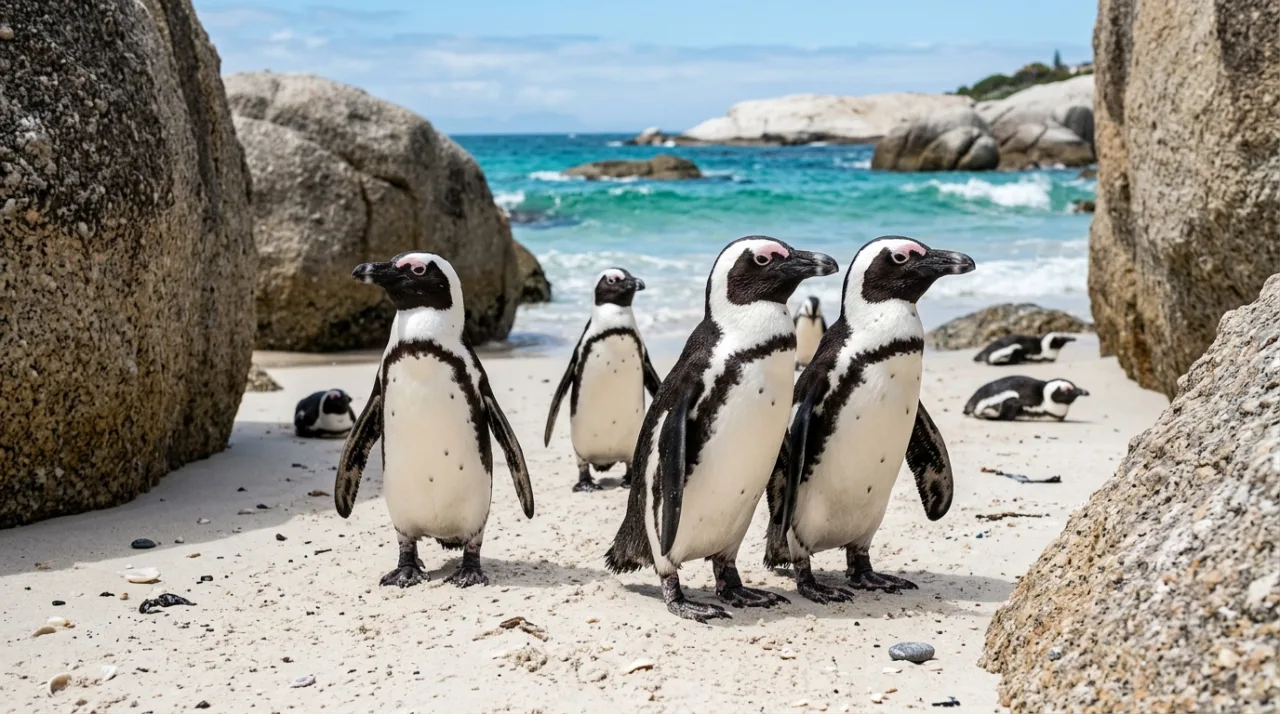
Sound familiar? You want a genuinely wild penguin encounter without a cruise ship, a Drake Passage crossing, or a multi-day expedition. Boulders Beach, inside Table Mountain National Park near Cape Town, is close to the only place on the list where that’s actually possible.
A breeding pair of African penguins first settled at Boulders Beach in 1982, and the colony has grown from there into a genuine tourist attraction sitting inside an otherwise ordinary suburban beach. The 2026 annual census recorded 790 breeding pairs at Boulders, up from 698 pairs the year before, putting the colony’s total population at an estimated 2,528 individual birds, according to South African National Parks (SANParks). That’s roughly 8 to 9% of the entire South African African penguin population concentrated on one short stretch of coastline.
Common Mistake:Assuming the species is doing fine because Boulders looks busy. African penguins were uplisted from Endangered to Critically Endangered by the IUCN in October 2024, with the global breeding population estimated at just under 10,000 pairs, down from roughly 141,000 pairs in the 1950s. The uptick at Boulders is genuinely encouraging, but conservationists are careful to call it a sign of stability rather than a full recovery.
The appeal here is access, not scale. Wooden boardwalks run directly from the visitor center to the beach, and unlike Punta Tombo or the Antarctic Peninsula, Boulders is a same-day trip from a major international airport, with no ship, permit, or multi-day itinerary required.
Australia and New Zealand: The World’s Smallest Penguins
Little penguins (Eudyptula minor), the smallest species in the family at around 1 kilogram and 33 centimeters tall, are the only penguin species native to Australia, and Phillip Island’s Summerland Peninsula colony is the largest in the world at roughly 32,000 to 40,000 birds depending on the year’s census.
The nightly Penguin Parade there is genuinely wild. The birds aren’t fed, trained, or held in any way — they simply come ashore from Bass Strait at dusk, every single night of the year, and the visitor infrastructure is built entirely around that existing behavior rather than the other way around. Numbers vary hugely by season: as few as 50 to 200 penguins on a quiet winter night, and 3,000 to 5,000 or more during peak spring and summer chick-rearing months. The Penguin Parade alone drew 709,673 visitors in 2025, with the broader Nature Parks — which also includes the Koala Conservation Reserve and Churchill Island — surpassing one million total visitors for the year, according to Phillip Island Nature Parks’ own figures.
Pro Tip:Book well ahead for November through January visits. That window delivers by far the highest penguin counts, but it also means the parade sells out most nights during peak Australian summer holidays.
New Zealand hosts several species too, including the yellow-eyed penguin and, on the South Island, small colonies of little penguins, though nothing on Phillip Island’s scale. For travelers combining Australia and New Zealand into one trip, it’s worth treating Phillip Island as the headline stop and any New Zealand sighting as a bonus rather than the main event.
Comparison: Six Penguin Destinations at a Glance
Destination | Species You’ll See | Typical Trip Length | Cost Level | Best For |
Antarctic Peninsula | Gentoo, chinstrap, Adélie (emperor via fly-in only) | 8–14 days round trip | High | Bucket-list wildlife cruises |
Punta Tombo, Argentina | Magellanic | 1 day (from Puerto Madryn/Trelew) | Low–Moderate | Budget-friendly, huge colonies |
Falkland Islands | King, gentoo, rockhopper, Magellanic | 3–7 days | Moderate–High | Species variety, close approach |
Boulders Beach, South Africa | African | A few hours from Cape Town | Low | Same-day access, no ship required |
Phillip Island, Australia | Little penguin | A few hours from Melbourne | Low | Guaranteed nightly sighting, families |
Accredited zoo/aquarium | 1–4 species depending on facility | A few hours | Low | No travel required at all |
Can’t Travel Far? Seeing Penguins at a Zoo
Not everyone can book a Drake Passage crossing or a flight to Cape Town, and that’s fine. A well-run, accredited zoo or aquarium is a legitimate way to see penguins up close, especially for kids or anyone facing mobility or budget constraints. Facilities accredited by bodies like the AZA in the U.S. or equivalent organizations elsewhere typically house species such as African, Humboldt, or gentoo penguins in habitats built around each species’ actual climate needs, not in a generic cold room with some fake ice.
You want the experience without the 20-hour flight and the seasickness. A good zoo penguin exhibit, especially one with underwater viewing, genuinely delivers on that. You can watch feeding behavior and swimming technique at a distance no wild colony visit will match. It’s a different kind of encounter, not a lesser one, and it’s frequently tied to active conservation and breeding programs for threatened species like the African penguin covered above.
Pro Tip:Look specifically for AZA, EAZA, or equivalent regional accreditation before booking a “penguin encounter” experience. Accreditation is the clearest signal that a facility funds real conservation work rather than functioning as a roadside attraction.
Responsible Penguin-Watching: 6 Tips
Keep your distance.IAATO and most reserves require a minimum of 5 meters, about 15 feet, from wildlife, closer only if a penguin approaches you, never the other way around.
Stay on marked paths.Off-trail walking disturbs burrows you may not even see, especially at ground-nesting sites like Punta Tombo and Boulders Beach.
Skip the flash photography.It stresses nesting birds and offers no real benefit to your photos in daylight or dusk conditions anyway.
Travel with IAATO-member operatorsif you’re headed to Antarctica. Membership means the operator follows agreed biosecurity and wildlife-approach protocols across the industry.
Visit in shoulder monthsif crowds concern you. November and March both offer strong wildlife activity with noticeably fewer visitors than peak January.
Support accredited facilitiesif you’re seeing penguins at a zoo. Accreditation is the difference between genuine conservation funding and a roadside attraction with the same animal on display.
FAQ
Do penguins live in the Arctic?
No. Penguins live only in the Southern Hemisphere, primarily Antarctica, southern Africa, South America, Australia, and New Zealand. The one exception, the Galápagos penguin, lives at the equator, still nowhere near the Arctic.
Are penguins only found in Antarctica?
No. While five species breed in and around Antarctica, most of the 18 recognized penguin species live elsewhere, including Argentina, Chile, South Africa, Australia, New Zealand, and the Galápagos Islands.
Where do penguins live in South America?
Penguins in South America are concentrated along the coasts of Argentina, Chile, and Peru. Argentina’s Punta Tombo hosts the largest colony, while Chile and Peru support smaller Magellanic and Humboldt penguin populations, respectively.
When is the best time to see penguins in Patagonia?
September through March is the breeding season in Patagonia. October to January is the peak period, covering nesting, egg-laying, and early chick-rearing, before many colonies begin migrating north again by April.
Can I see penguins at a zoo?
Yes. Accredited zoos and aquariums worldwide house species like African, Humboldt, and gentoo penguins in climate-appropriate habitats, often as part of conservation and breeding programs for threatened species.
The Bottom Line
Penguins aren't hiding at the North Pole, and they're not exclusively an Antarctic animal either. The best places to see penguinsspan an entire hemisphere: Antarctica's Peninsula for gentoo and chinstrap colonies, Argentina's Punta Tombo for the largest Magellanic gathering on Earth, Boulders Beach for a same-day African penguin encounter, Phillip Island for a guaranteed nightly parade, and your local accredited zoo whenever travel isn't in the cards at all. Whichever route you choose, keep your distance, book with reputable operators, and let the penguins set the terms of the encounter. Bookmark this guide before you start comparing flights, send it to whoever you're dragging along on the trip, and let it be your starting point whichever destination you end up choosing.
Explore more wildlife guidesand stories.