

Can You Make Natural Sunscreen at Home?
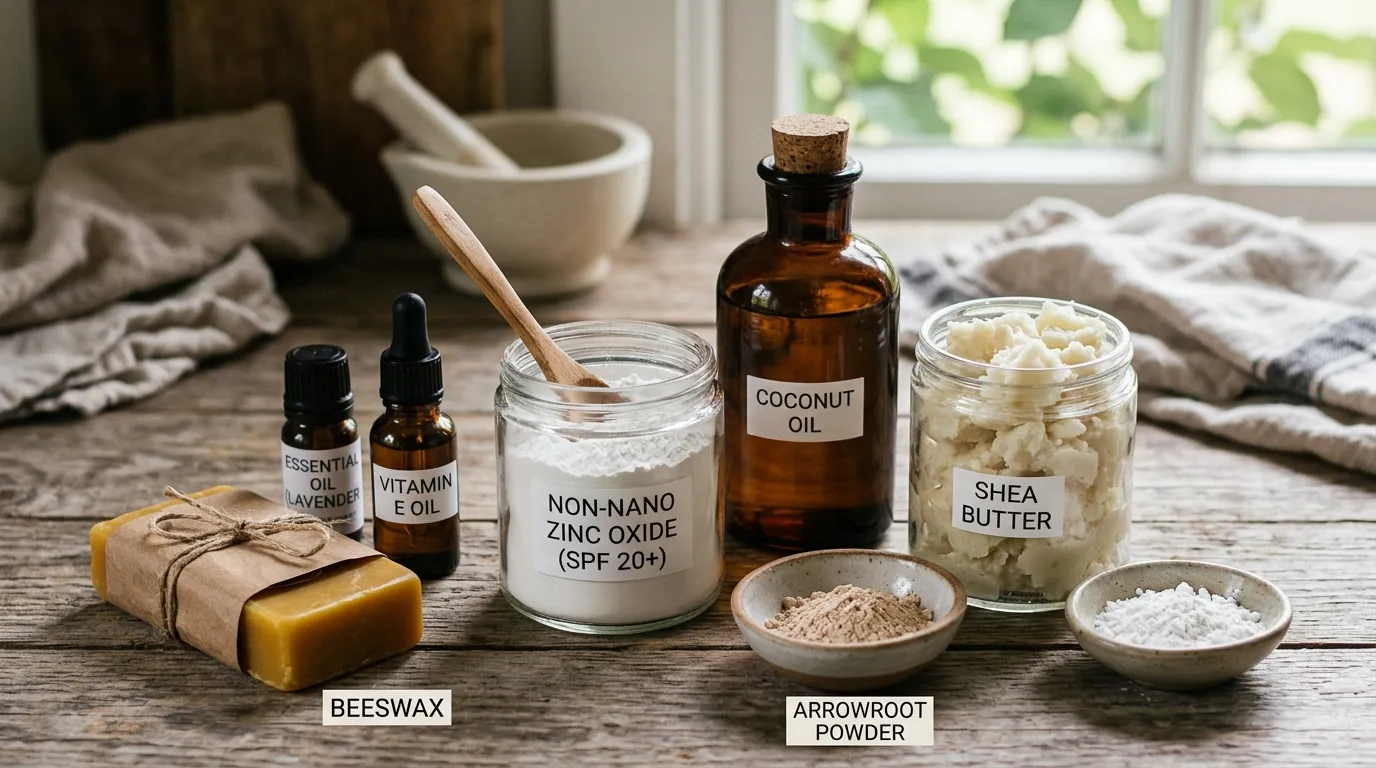
You can make a zinc-based balm at home with ingredients common in DIY sunscreen recipes. Typically, you melt oils, plant butters, and beeswax, then mix in zinc oxide.
However, you cannot make a sunscreen at home that has a verified SPF.
A homemade mixture might include a known UV filter, but that does not mean it offers even, broad-spectrum, or water-resistant protection. Commercial sunscreens are tested to see how much ultraviolet radiation they block.
For reliable sun protection, choose a tested broad-spectrum sunscreen with SPF 30 or higher. Treat homemade zinc balms as experimental cosmetics, not as substitutes for regulated sunscreen.
What Does “Natural Sunscreen” Mean?
There is no single scientific definition for “natural sunscreen.” The FDA has not set a regulatory meaning for “natural” on cosmetic labels, and just because an ingredient is natural does not mean it is safer or works better.
Most people use the term to describe one of two things:
A mineral sunscreen containing zinc oxide or titanium dioxide
A homemade mixture containing plant oils, butters, wax, and zinc oxide
These two products are not the same.
A tested mineral sunscreen has a measured SPF and must meet labeling rules. A homemade mixture does not have a confirmed SPF unless the whole finished product has been tested under standard conditions.
How Does Sunscreen Protect Your Skin?
Sunlight contains UVA and UVB radiation.
UVB rays are the main cause of sunburn. UVA rays go deeper into the skin and can lead to early aging and skin damage. Broad-spectrum sunscreen is made to protect against both.
Mineral UV filters like zinc oxide and titanium dioxide absorb and scatter ultraviolet rays. How well they work depends on more than just how much you add.
Effective protection also depends on:
Particle size and surface treatment
Even distribution throughout the formula
How the product spreads across the skin
The thickness of the applied layer
Formula stability
Resistance to sweat and water
Protection across UVA and UVB wavelengths
That’s why simply adding zinc oxide to a jar of lotion does not make it an SPF 30 sunscreen.
Ingredients Commonly Used in Homemade Natural Sunscreen
Most online recipes combine a mineral powder with moisturizing ingredients. Each ingredient has a different purpose.
Zinc oxide | Mineral UV filter | It can filter UV radiation, but the finished product requires testing |
Titanium dioxide | Mineral UV filter | It can provide UV protection in a properly formulated and tested product |
Coconut oil | Emollient and spreadable base | No reliable or adequate protection on its own |
Jojoba, almond or avocado oil | Improves texture and skin feel | No verified sunscreen protection |
Shea or cocoa butter | Thickens and moisturizes | No dependable SPF |
Beeswax | Makes the balm firmer and more water-repellent | Does not make a product tested or waterproof |
Aloe vera | Adds moisture or a cooling feel | Does not provide dependable UV protection |
Vitamin E | Antioxidant and oil-phase ingredient | Does not establish an SPF |
Essential oils | Fragrance | Do not provide reliable protection and may irritate skin |
Cocoa powder | Changes the tint | Does not create tested UVA or UVB protection |
A review of homemade sunscreen formulas found that coconut oil, shea or cocoa butter, beeswax, and zinc oxide were among the most common ingredients. The same review found that popular SPF claims for plant oils and homemade zinc mixtures were not supported by clinical testing of the finished products.
Zinc Oxide
Zinc oxide is the ingredient that gives many mineral sunscreens their UV-filtering ability. It can contribute to broad-spectrum protection when it is correctly selected, dispersed, stabilized, and tested in a complete formula.
The main issue is how the zinc is spread throughout the mixture.
Zinc particles can clump together in tiny groups. The mixture might look smooth, but there could be small spots with less protection. Household whisks and blenders cannot guarantee the zinc is spread out evenly.
Loose zinc oxide powder can get into the air when you measure or mix it. Avoid breathing in cosmetic powders, and remember that mixing at home is not the same as professional product making.
Oils and Plant Butters
Coconut oil, olive oil, almond oil, jojoba oil, shea butter, and cocoa butter help make a balm smoother and easier to apply. They also soften the skin and help keep in moisture.
But their cosmetic benefits are not the same as actual sun protection.
Lab tests on single oils do not prove that they protect your skin in real life. Recent studies show that plant oils do not absorb enough UVB rays to work as reliable sunscreens.
Beeswax
Beeswax makes the mixture thicker and leaves a longer-lasting layer on your skin. It might help the balm resist a little moisture, but it does not make it waterproof or water resistant by sunscreen standards.
Commercial sunscreens labeled water-resistant are tested to see if they still protect after 40 or 80 minutes in water. Homemade balms cannot make this claim without similar testing.
Essential Oils
Essential oils are usually added for their scent, not for sun protection.
Some citrus oils, including bergamot, lemon, lime, grapefruit, and bitter orange, can cause phototoxic skin reactions when exposed to ultraviolet light. Fragrance ingredients may also trigger irritation or allergic reactions.
It’s usually easier to skip essential oils, especially if you have sensitive skin.
How People Commonly Make Homemade Natural Sunscreen
Most online guides for makingnatural sunscreenuse the same basic steps.
The steps below show this common process for learning purposes. They do not create a sunscreen with a confirmed SPF.
Step 1: Prepare an Oil-Based Mixture
You start by mixing a plant butter, like shea or cocoa butter, with a carrier oil. Common choices include coconut, jojoba, almond, olive, or avocado oil.
These ingredients make up the moisturizing base, but they are not the main UV filters.
Step 2: Add Wax
Beeswax is added to thicken the mixture and help it stay on your skin. Using more wax makes a firmer balm, while less wax gives you a softer cream.
Wax changes the texture, but it does not make the product water resistant.
Step 3: Melt the Base
Melt the oils, butter, and wax together gently, usually using indirect heat.
If your recipe includes water, aloe gel, or other water-based ingredients, you need a proper emulsifier and preservative. Without these, the mixture can separate or grow bacteria. Homemade cosmetics can get contaminated from ingredients, tools, storage, or repeated use.
Step 4: Mix in Zinc Oxide
Most online recipes suggest letting the melted base cool a bit before adding zinc oxide powder.
This is the most important and hardest part to control. Mixing at home cannot guarantee the zinc particles are spread out evenly at a tiny scale.
Adding extra zinc does not let you figure out an accurate SPF.
Step 5: Blend and Cool
Blend the mixture, pour it into a container, and let it cool into a cream or balm.
The finished product might look and feel like mineral sunscreen, but looks do not guarantee protection.
Step 6: Label It Honestly
Do not label a homemade product as SPF 15, SPF 30, broad spectrum, or water resistant unless it has been properly tested.
The safest way to describe it is as a “zinc-based skin balm” or “mineral body balm.” Do not count on it for sun protection during outdoor activities like swimming, hiking, sports, or beach trips.
Why Homemade Sunscreen Cannot Provide a Verified SPF
You cannot figure out SPF just by looking at the ingredient list.
The FDA describes SPF as a value measured by comparing the amount of UV exposure required to cause sunburn with and without the finished sunscreen applied. The complete product must be tested, not just its individual ingredients.
There are several reasons why homemade SPF estimates are not reliable.
Zinc Oxide Does Not Disperse Automatically
Zinc oxide particles tend to collect together. Professional formulators use specialized raw materials, dispersing agents, controlled processing, and high-shear equipment to distribute mineral filters.
A kitchen blender might get rid of visible lumps, but it can still leave tiny gaps you cannot see.
SPF Does Not Confirm UVA Protection
SPF mainly reflects protection against sunburn, which is largely caused by UVB. A product must also pass broad-spectrum testing to demonstrate adequate UVA protection.
A homemade formula cannot prove either type of protection.
The Formula Can Change During Storage
Heat, light, moisture, time, and temperature changes can all affect a product’s texture and how its ingredients are distributed. Water-containing formulas can become contaminated. A product that looked uniform when it was made may not remain uniform.
Application Is Uneven
Sunscreen tests use a set amount for application, but in real life, people often use too little.
This issue is even bigger with homemade mixtures because you do not know their starting SPF.
Water Resistance Requires Testing
A thick, waxy product might still be visible after swimming, but it can lose much of its protective layer.
Just because a product stays on your skin does not mean it keeps its tested SPF.
Natural Ingredients That Do Not Replace Sunscreen
Many ingredients are often described online as natural SPF alternatives, but these claims should be viewed with caution.
Coconut Oil
Coconut oil is a useful moisturizer, but it does not provide dependable broad-spectrum protection. It should not be used alone before sun exposure.
Red Raspberry Seed Oil
Claims that raspberry seed oil provides an SPF similar to commercial sunscreen have not been confirmed through clinical testing of sunscreen products.
It may work as an emollient, but it is not a substitute for labeled SPF.
Carrot Seed Oil
DIY recipes often claim carrot seed oil has a high SPF, but these numbers are not backed up by standard tests showing it protects human skin as a finished sunscreen.
Shea Butter and Cocoa Butter
These butters help moisturize and thicken a balm, but they do not provide reliable enough protection to replace sunscreen.
Aloe Vera
Aloe can feel soothing on dry or irritated skin, but it does not prevent UV damage and should not be used as sunscreen.
Essential Oils
Essential oils do not provide reliable SPF, and some can make your skin more sensitive or irritated in sunlight.
A Safer Way to Choose Natural Sunscreen
If you prefer mineral or fragrance-free products, there are many tested commercial options available.
Look for these words on the label:
Broad spectrum:Protects against UVA and UVB radiation
SPF 30 or higher:The minimum level recommended by the American Academy of Dermatology
Water resistant:Especially important for swimming, exercise, or hot weather
Zinc oxide or titanium dioxide:Common mineral UV filters
Fragrance-free:Often preferable for reactive or sensitive skin
The American Academy of Dermatology suggests picking a broad-spectrum, water-resistant sunscreen with SPF 30 or higher.
Tinted mineral sunscreen can be easier to use on deeper skin tones because the tint helps reduce the white cast. Tinted products with iron oxides also give extra protection from visible light, which can help people who get dark spots.
How to Apply Tested Sunscreen Correctly
Even the best sunscreen will not work properly if you do not use enough.
For better protection:
Apply sunscreen about 15 minutes before going outdoors.
Cover all exposed skin, including the ears, neck, feet, hairline, and scalp.
Most adults need about one ounce of sunscreen to cover all exposed skin.
Use a generous, even layer on the face.
Reapply every two hours.
Reapply immediately after swimming or heavy sweating.
Follow the product’s 40-minute or 80-minute water-resistance directions.
Sunscreen works best when it is part of a bigger sun-safety routine. Wear protective clothing, a wide-brimmed hat, stay in the shade, and avoid direct sun when it is strongest.
Common Mistakes When Making Homemade Sunscreen
Assigning an SPF Based on Zinc Percentage
Having a certain amount of zinc oxide does not guarantee a specific SPF. How it is spread, how the film forms, particle treatment, and the rest of the formula all matter.
Mixing Zinc Oxide Into Finished Lotion
Adding zinc to a moisturizer can affect how well it keeps, its stability, and its texture. It also does not make sure the zinc is spread out evenly.
Assuming More Zinc Means More Protection
Adding more powder can make the product heavy and patchy without giving you the SPF you expect. It can also make it hard to spread evenly.
Counting Plant Oils as SPF
Coconut, raspberry seed, carrot seed, and similar oils should be seen as cosmetic oils, not as actual sunscreen ingredients.
Calling a Wax-Based Balm Waterproof
Beeswax might make a product feel water-repellent, but there is no such thing as waterproof sunscreen. Even tested water-resistant sunscreens need to be reapplied after swimming or sweating.
Adding Citrus Essential Oils
Some citrus oils can react with sunlight and irritate or harm your skin. They only add fragrance, not protection.
Making a Large Batch
Homemade products can separate, go bad, or get contaminated. Formulas with water are especially hard to keep safe outside a professional setting.
Testing It by Waiting to See Whether You Burn
Not getting a visible sunburn does not mean your skin avoided UVA damage. Personal tests cannot measure SPF or broad-spectrum protection.
Frequently Asked Questions
Can you make effective sunscreen at home?
You can make a zinc oxide-based balm, but you cannot verify its SPF, UVA protection, stability, or water resistance without standardized laboratory testing. It should not replace a tested broad-spectrum sunscreen.
How much zinc oxide is needed for SPF 30?
There is no reliable household conversion between zinc oxide percentage and SPF 30. The finished formula must be tested because SPF depends on dispersion, particle properties, film formation, and other ingredients.
Can I add zinc oxide to my regular lotion?
Adding zinc oxide to lotion is not recommended for making sunscreen. The powder may not distribute evenly and can affect the lotion’s stability and preservation.
Does coconut oil work as sunscreen?
No. Coconut oil may reduce dryness, but it does not provide reliable or sufficient broad-spectrum UV protection.
Does raspberry seed oil have a natural SPF?
Claims assigning high SPF values to raspberry seed oil have not been confirmed through standardized clinical sunscreen testing. Do not use it as a replacement for labeled sunscreen.
Is homemade sunscreen waterproof?
No. A waxy balm may repel some water, but water resistance must be measured through formal testing. Homemade products should not be described as waterproof or water resistant.
Is zinc oxide a natural sunscreen ingredient?
Zinc oxide is a mineral-derived UV filter used in many tested sunscreens. Its origin does not guarantee protection on its own. It must be properly formulated and tested as part of the finished product.
Is mineral sunscreen safer for sensitive skin?
Many people with sensitive skin prefer fragrance-free mineral sunscreen containing zinc oxide or titanium dioxide. Patch-test a new product and speak with a dermatologist if sunscreen regularly causes burning, swelling, itching, or a rash.
Can I use homemade natural sunscreen on a baby?
Do not rely on homemade sunscreen for babies or children. For babies younger than six months, shade and protective clothing should be the first choices. When those are not available, the American Academy of Dermatology advises using only a minimal amount of tested, broad-spectrum, water-resistant SPF 30 sunscreen on exposed skin.
What is the safest alternative to DIY sunscreen?
Choose a tested mineral sunscreen labeled broad-spectrum, SPF 30 or higher, and water-resistant. Combine it with shade, protective clothing, sunglasses, and a wide-brimmed hat.
Final Takeaway
When you learn how to make natural sunscreen, you see an important difference: making a balm is easy, but making a reliable sunscreen is not.
You can mix oils, shea butter, beeswax, and zinc oxide to make a smooth homemade product. It might moisturize your skin and leave a visible mineral layer, but it still cannot give you a verified SPF, proven UVA coverage, tested water resistance, or guaranteed stability.
Use DIY formulas only as cosmetic balms. For real sun protection, pick a tested broad-spectrum mineral sunscreen with SPF 30 or higher and use it generously.
Before your next day outside, check the sunscreen you already have. Make sure it is broad-spectrum, SPF 30 or higher, and water resistant. A sunscreen you like and use often is much better than an untested homemade recipe.