
How Many Teeth Do Adults Have?
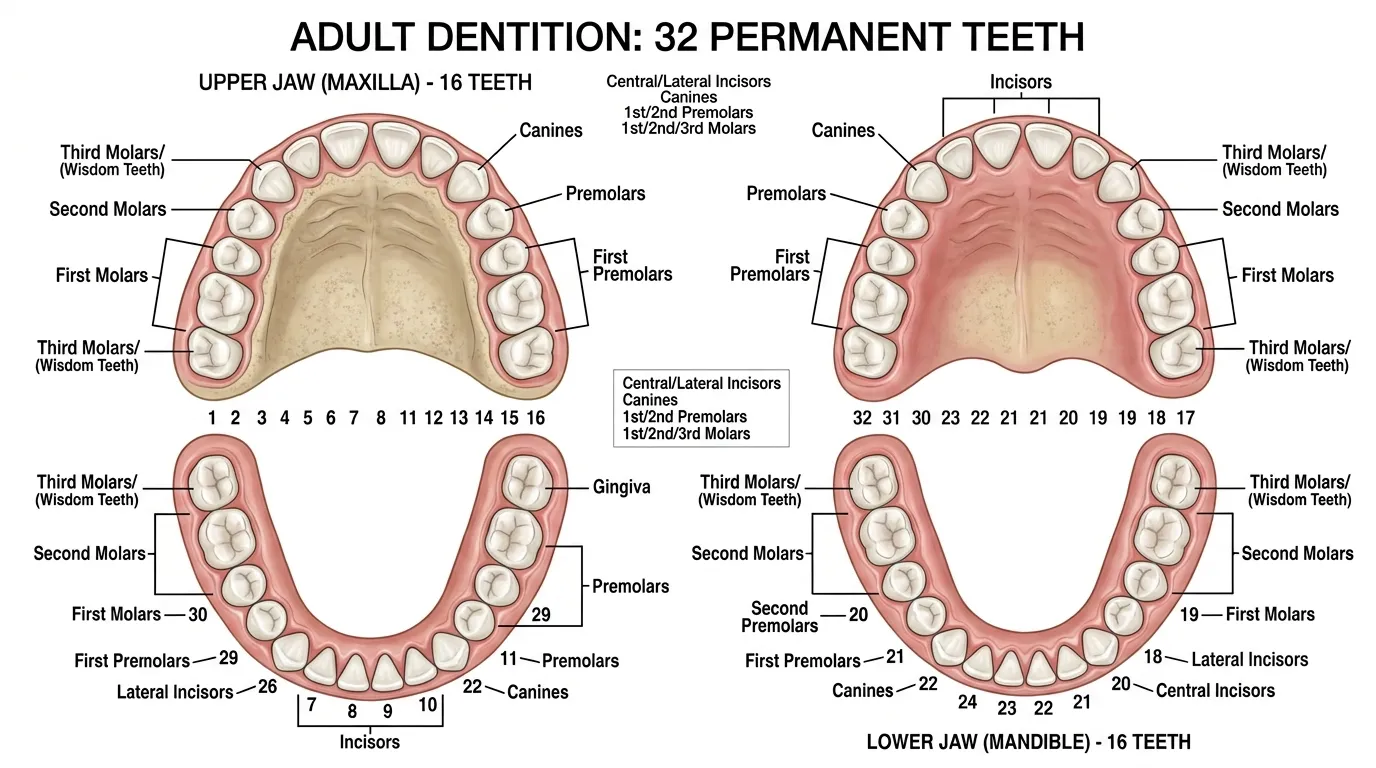
Most adults have 32 permanent teeth in total. This number includes:
8 incisors
4 canines
8 premolars
12 molars, including 4 wisdom teeth
Teeth are usually split evenly, with 16 on the top and 16 on the bottom. If you do not have wisdom teeth, you will likely have 28 permanent teeth. Both numbers are considered normal.
You might have a different number of teeth. Some people never get wisdom teeth. Others may have teeth that are still under the gums, have been removed, or were lost because of decay, gum disease, or injury.
This guide will help you understand why adults can have 28, 32, or a different number of teeth. It also explains what each type of tooth does and how to keep your teeth healthy.
Adult Teeth Count at a Glance
32 teeth | Full permanent set with four wisdom teeth |
31 teeth | One wisdom tooth is absent, unerupted, removed, or another tooth is missing |
30 teeth | Two wisdom teeth are absent or removed, or other teeth are missing |
29 teeth | Three wisdom teeth are absent or removed, or other teeth are missing |
28 teeth | All four wisdom teeth are absent or removed |
Fewer than 28 | Other permanent teeth may be missing, removed, or lost |
More than 32 | One or more extra, or supernumerary, teeth may be present |
The number of teeth you have does not always show how healthy your mouth is. Someone with 28 healthy teeth can have better oral health than a person with 32 teeth that have decay or gum disease.
How Many Teeth Do Adults Have With and Without Wisdom Teeth?
Adults usually have 32 teeth if they haveall four wisdom teeth,or 28 teeth if they do not. Wisdomteeth are the third and final set of molars. They sit at the back of the mouth, with one possible wisdom tooth in each of the four dental quadrants.
The American Dental Association’s eruption chart shows that all 32 permanent teeth have usually emerged by age 21. However, this pattern varies. A wisdom tooth may develop but remain partly or completely beneath the gum, while another person may never develop one at all.
Is it normal to have 28 teeth?
Yes, it is normal to have 28 teeth if you do not have wisdom teeth.
You may have 28 teeth because:
Your wisdom teeth were removed.
They never developed.
They are still beneath the gums.
Only some wisdom teeth developed.
A dental X-ray is usually the best way to find out if your wisdom teeth are missing or just have not come in yet.
Do wisdom teeth count as adult teeth?
Yes. Wisdom teeth are permanent adult teeth.
They are included among the 12 adult molars. Without them, the mouth contains eight molars rather than 12.
Wisdom teeth do not automatically need to be removed. A dentist evaluates their position, cleanliness, effect on nearby teeth, and whether they are causing pain or infection.
Types of Adult Teeth and Their Functions
Adults have four main types of permanent teeth. Each type has a shape that helps with a different part of biting and chewing.
Type of tooth | Number in a full adult set | Main function |
Incisors | 8 | Biting and cutting food |
Canines | 4 | Gripping and tearing food |
Premolars | 8 | Crushing and beginning the grinding process |
Molars | 12 | Grinding and crushing food |
Total | 32 |
There are 12 molars in total, including four wisdom teeth. If you do not have wisdom teeth, you will usually have eight molars and 28 teeth overall.
A simple adult tooth diagram
Each quarter of a full adult mouth contains:
2 incisors → 1 canine → 2 premolars → 3 molars
Dentists divide the mouth into four quadrants:
Upper right
Upper left
Lower right
Lower left
Each section of your mouth has eight teeth if the wisdom tooth is there.
So, 8 teeth in each of the 4 sections adds up to 32 permanent teeth.
Without the third molar in each quadrant:
If you have 7 teeth in each section, that makes 28 permanent teeth.
How Many Teeth Are on the Top and Bottom?
A full set of adult teeth usually includes:
16 teeth in the upper jaw
16 teeth in the lower jaw
Without wisdom teeth, the usual count is:
14 teeth in the upper jaw
14 teeth in the lower jaw
Each full row contains four incisors, two canines, four premolars, four regular molars, and two wisdom teeth.
The number of teeth on the top and bottom is not always the same. You might have had a tooth removed from just one jaw, or only some wisdom teeth may have come in.
Why Do Some Adults Have Fewer Than 32 Teeth?
Having less than 32 teeth is not always a problem. What matters most is why you have fewer teeth.
Wisdom teeth are absent.
The most common reason for having 28 teeth is not having wisdom teeth. They might never have grown in, could still be under the gums, or may have been taken out.
A permanent tooth never developed.
Some people are born without one or more permanent teeth. This is called hypodontia. It can affect wisdom teeth or other teeth, such as premolars and lateral incisors.
You might not notice a missing permanent tooth without a dental exam or X-ray. Sometimes, a baby tooth stays in place because there is no permanent tooth underneath.
Teeth were intentionally removed.
Dentists may remove permanent teeth if they are badly damaged, infected, crowded, or causing bite problems. Removing wisdom teeth is a common example.
Teeth were lost
Adults can lose teeth because of:
Untreated tooth decay
Advanced gum disease
Accidents or sports injuries
Cracks or fractures
Severe infection
Losing a tooth is not the same as being born without one. If you notice a new gap after a tooth falls out or becomes loose, see your dentist.
Can Adults Have More Than 32 Teeth?
Yes, although it is less common.
Extra teeth are called supernumerary teeth, and having them is called hyperdontia. These extra teeth can show up anywhere in your mouth. They might look like regular teeth, be smaller or oddly shaped, or stay hidden under the gum.
An extra tooth does not always cause symptoms. It can sometimes:
Crowd nearby teeth
Block another tooth from erupting.
Create areas that are difficult to clean.
Affect the bite
Be visible only on an X-ray.
Having 33 or more teeth does not always mean there is a problem. Still, it is a good idea to see a dentist, especially if the extra tooth causes pain, crowding, or is hard to clean.
Basic Adult Tooth Anatomy
Each adult tooth has two main sections:
Crown:The visible part above the gumline
Root:The part below the gum that anchors the tooth in the jaw
Each part of the tooth has several layers inside.
Enamel
Enamel covers the crown. It is the hard outer surface that protects the tooth during biting and chewing.
Enamel is strong and can handle a lot of pressure, but acids from plaque can slowly weaken it. If a cavity forms, the lost enamel will not grow back.
Dentin
Dentin is found under the enamel and forms most of the tooth. It is not as resistant to decay as enamel.
If the enamel gets thin, damaged, or worn away, the dentin underneath can become exposed and cause sensitivity.
Pulp
The pulp is the soft center of the tooth. It contains nerves, connective tissue, and blood vessels.
Serious decay, cracks, or injuries can irritate or infect the pulp, which often leads to pain or sensitivity.
Cementum
Cementum covers the root of the tooth and helps connect it to the tissues that hold the tooth in your jaw.
How to Count Your Adult Teeth
You can count your teeth at home using a mirror, clean hands, and good lighting.
Begin on the upper right side and count across your upper jaw. Then, count from one side of your lower jaw to the other.
Use these tips:
Count each visible tooth once.
Include partially erupted teeth.
Check behind the last visible molars for wisdom teeth.
Do not count dental implants, bridge units, or denture teeth as natural teeth.
Keep in mind that some teeth may be hidden under the gum and not visible.
Counting your teeth at home is not perfect. Back teeth can be hard to see, and teeth that have not come in yet need an X-ray to find.
Common mistakes when counting adult teeth
A common mistake is thinking everyone should have 32 visible teeth. Some wisdom teeth stay hidden or never develop.
People sometimes think crowns are extra teeth, but a crown just covers a natural tooth and does not add to your tooth count.
Dental implants look and work like real teeth, but they are replacements, not natural teeth. So, you might see 28 tooth-like structures, but have fewer than 28 natural teeth.
Arrange routine dental examinations.
How often you need dental check-ups depends on your oral health and risk factors. Regular exams can catch decay, gum disease, cracked teeth, and hidden wisdom teeth before they get worse.
See your dentist right away if you have ongoing pain, swelling, a broken or loose tooth, or bleeding that will not stop.
Frequently Asked Questions
How many teeth do adults have, 28 or 32?
Both 28 and 32 teeth are normal for adults. If you have all four wisdom teeth, you will have 32. Without them, you will usually have 28.
Should an adult have 28 or 32 teeth?
There is not one right number of teeth for everyone. Your total depends on whether your wisdom teeth grew in, were removed, or if you are missing any other teeth.
How many teeth do adults have without wisdom teeth?
Most adults have 28 permanent teeth if they do not have wisdom teeth. This includes eight incisors, four canines, eight premolars, and eight molars.
Are wisdom teeth included in the count of 32?
Yes, the usual count of 32 teeth includes four wisdom teeth, which are also called third molars.
How many teeth are in the upper jaw?
A full upper jaw has 16 teeth. If you do not have the two upper wisdom teeth, you will usually have 14.
How many teeth are in the lower jaw?
A full lower jaw also has 16 teeth. Without the two lower wisdom teeth, it usually has 14.
Is it normal to have 30 teeth?
It can be. You may have two wisdom teeth rather than four, or you may have had two teeth removed. An examination can confirm which teeth are present.
Can an adult have 33 teeth?
Yes, having more than 32 teeth usually means you have an extra tooth, called a supernumerary tooth. Your dentist can check if it affects your other teeth or your bite.
Why do I have only 24 or 26 teeth?
You might have 24 or 26 teeth because you were born without some, had teeth removed, have teeth that have not come in, or lost teeth to decay, gum disease, or injury. A dental exam and X-ray can find the exact reason.
Do adult teeth grow back after they fall out?
Adult teeth do not grow back once they are lost. That is why you should see a dentist quickly if you have a loose, broken, or knocked-out tooth.
The Bottom Line
So, how many teeth do adults have?A full set has 32 permanent teeth, including four wisdom teeth. If you do not have wisdom teeth, you will usually have 28.
Having a different number of teeth is not always unhealthy. Some people never develop certain teeth, while others have teeth that are hidden, removed, lost, or extra. What matters most is the health of your teeth and gums, not the exact number.l.
Brush your teeth twice a day with fluoride toothpaste, clean between your teeth, avoid frequent sugary snacks, and visit your dentist regularly. These habits help your teeth last a lifetime.
Not sure how many natural teeth you have or whether your wisdom teeth have come in? A regular dental exam and X-ray can give you a clear answer and spot any issues that need attention.